
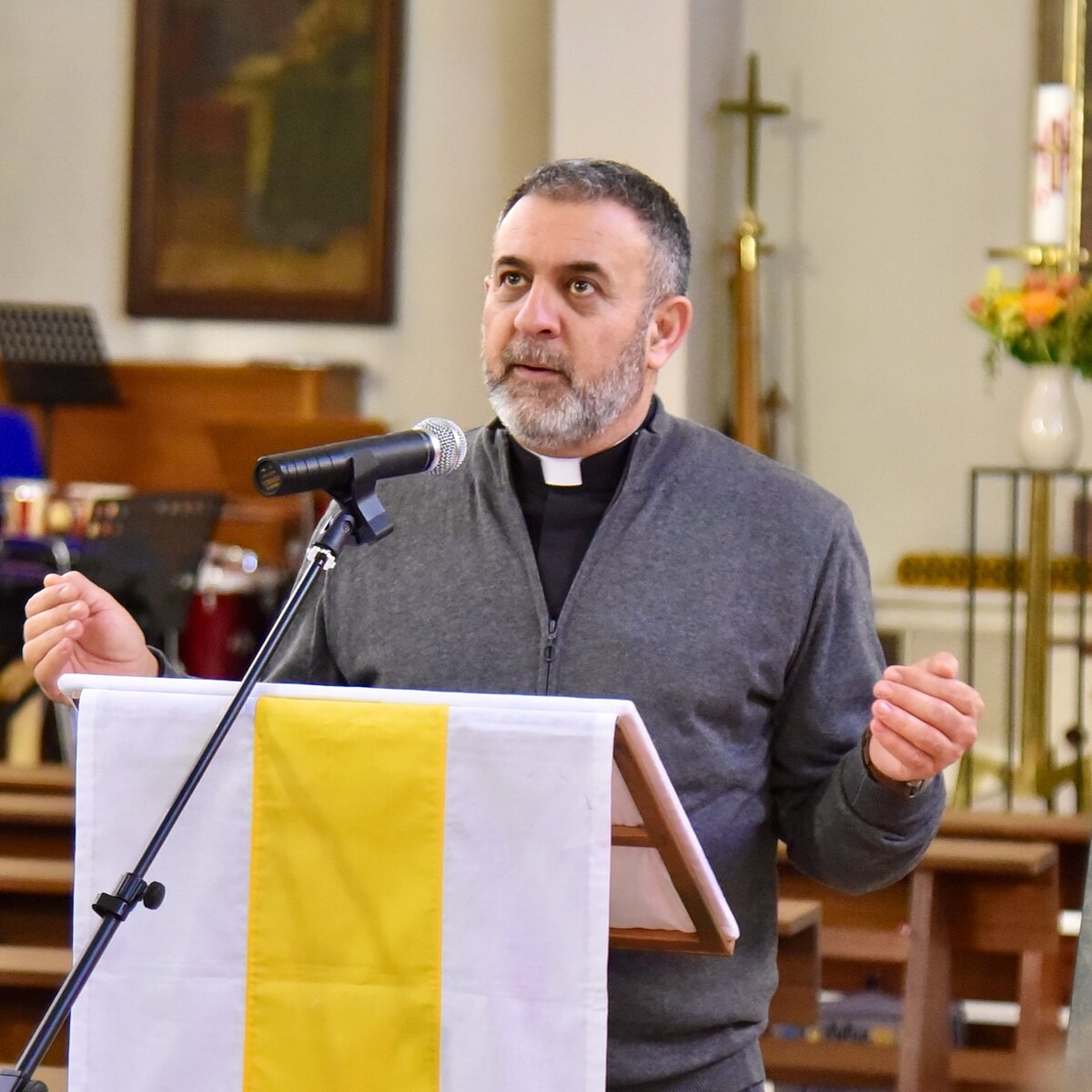
Father Fadi Diab: “All Christians must regard the difficulties in the Holy Land as their own”
On a visit to Luxembourg, the rector of the Anglican parish in Ramallah describes a dire situation.
They accounted for between 9 and 10 per cent in 1922, and 1.9 per cent in 2025. Observers estimate that Christians in the Holy Land now make up no more than 1 per cent of the population. Are the descendants of the first Christians, who have lived in the land of Jesus for two thousand years, set to disappear? Could the Holy Land become a museum? This is a very real question today, and it is dramatic in many respects. For the Christians living there, of course, because it is they whom we must be concerned about first and foremost. For the region itself, because this tiny Christian minority acts as a peacemaker. Finally, for Christendom, for this is the land that saw Christ’s birth, that saw him live, be put to death and rise again. Our faith is in Jesus; our religion is a loving relationship with a person. It is said that the Holy Land is the fifth Gospel. In the first four, Jesus, True God, speaks to us. By visiting the fifth, we encounter Jesus, True Man. Can we imagine that the descendants of those who knew Him are being driven from their homes?
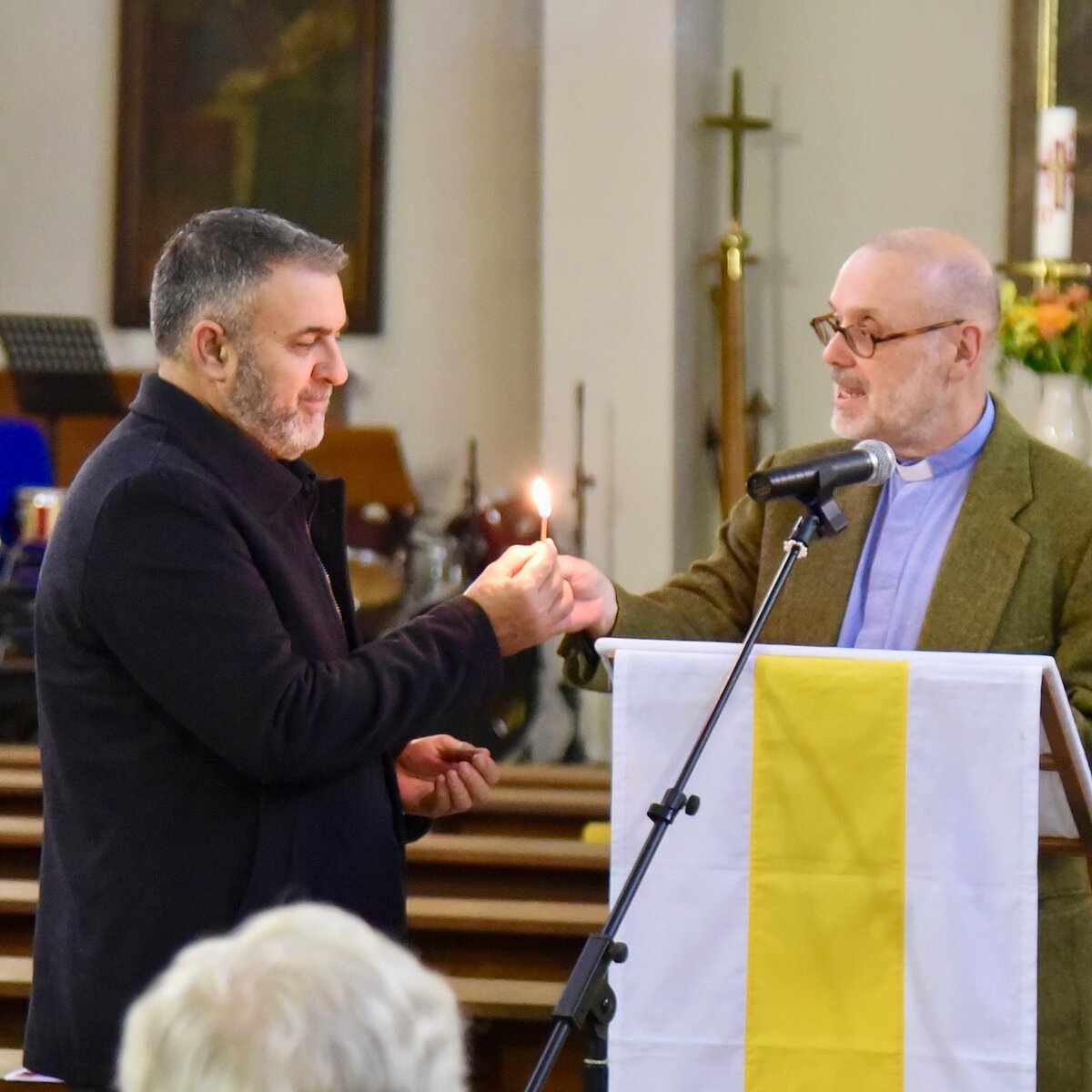
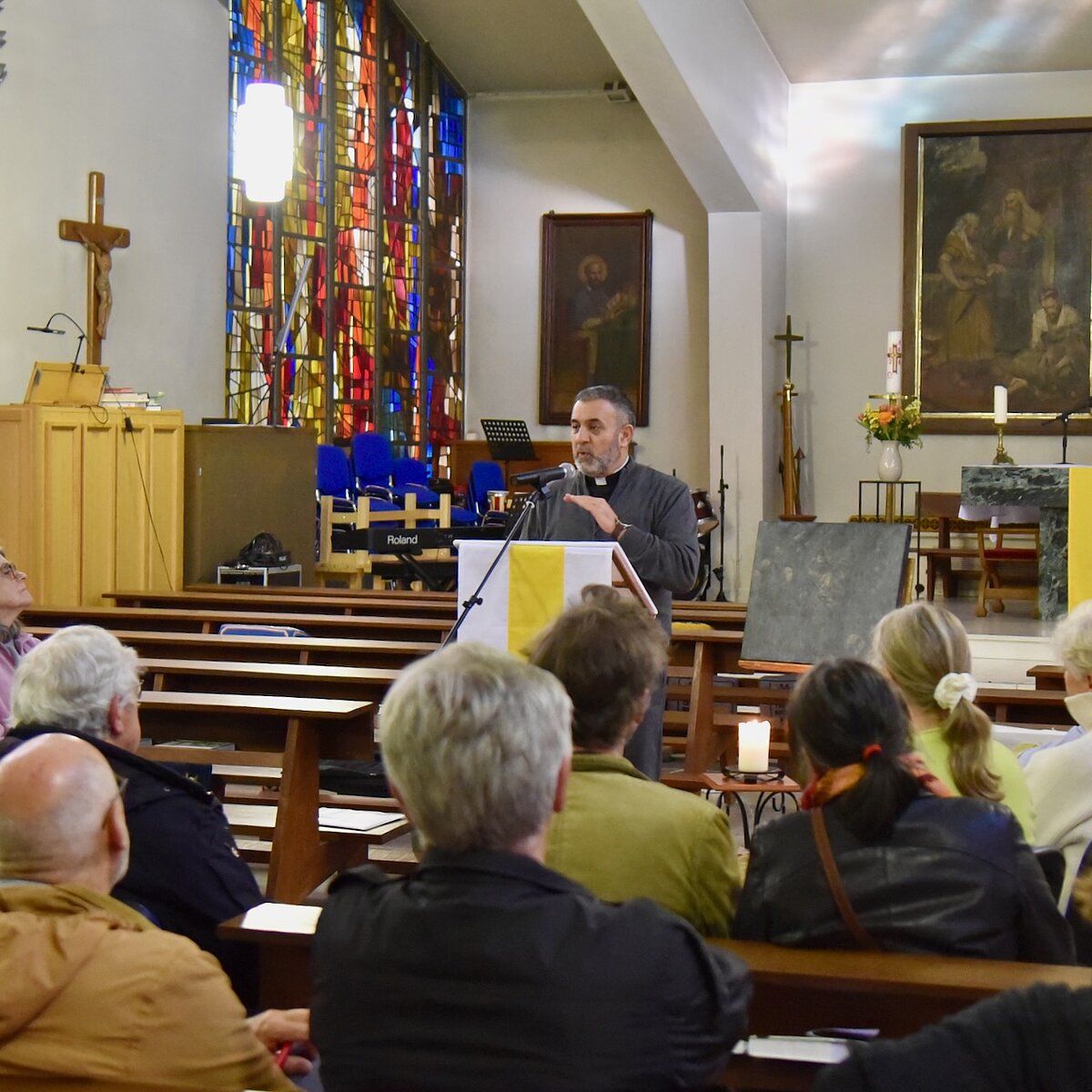
Religious leaders are sounding the alarm. On 10 March, Father Bashar Fawadleh, parish priest of Taybeh, the last entirely Christian village in the West Bank, was due to travel to Luxembourg to encourage the resumption of pilgrimages. On 28 February, the start of Israeli-American strikes on Iran made this trip impossible. Two months later, another witness from the Holy Land was able to board a plane and come to us. Father Fadi Diab, rector of the Anglican parishes of St Andrew in Ramallah and St Peter in Birzeit, spent a few days in Luxembourg. On the evening of 11 May, at the invitation of the Reverend Geoff Read of the Anglican Church of Luxembourg, he gave a talk and testimony as part of a special Siren Prayer service in the chapel of the Centre Convict.
Father Fadi Diab was born in the West Bank. Ordained as a priest in the Episcopal Church of Jerusalem (Anglican) in 2001, he has carried out his ministry partly in Jordan and partly in the West Bank. His words are calm, but the situation he describes is tragic. “Christianity is facing a critical moment in the Holy Land. The genocide in Gaza has made the situation even more visible. Twelve thousand Christians (*), mostly young people, have left since 7 October 2023 and the Hamas attack on Israel. Worldwide, there are one million Christians of Palestinian origin who have been forced into exile.” The war is obviously a major factor, but not the only one. “For the past two and a half years, the psychological, political and economic pressure to drive Christians away has been extreme. The attacks by radical Jews against us in my region are relentless,” says Father Fadi. “Spitting, vandalism, cars and houses set alight, crops destroyed… Over the last four months, the Israeli police have documented 600 acts of violence against Christians. The settlers enjoy complete impunity. If they are arrested, they are released after a few hours on the grounds that they were not of sound mind at the time of their actions. It even happens that these acts are committed by tourists from abroad!”
“I encourage everyone to write to their country’s leaders”
On the ground, the Christian leaders are not sitting idly by. They have condemned this violence on several occasions, sometimes joined by Orthodox rabbis. “The worst thing is the feeling of paralysis we experience,” explains Father Fadi. “On my way back from Jericho, my car was attacked by settlers who started throwing stones at the bodywork. I was with my son. If we’d got out of the car at that moment, we would have been killed. We have no one to turn to.” In Father Fadi’s community, Christians live in constant fear of attacks by Israeli settlers. “I have a parishioner, Layan Nasir, who has been imprisoned three times. The last time she was sentenced to eight months in prison and has only just been released. Others are arrested, released after a few weeks, and then arrested again. It’s another way of putting pressure on Christians to leave.”
Are international sanctions effective? “The State of Israel behaves as if it were above international law and presents itself as the United States’ best ally in the Middle East. Even within the European Union, some countries block resolutions against Israel.” At this stage, what can be done? “As Christians, we are called to change the world. We are not meant to stay in our comfort zone. All Christians must regard the difficulties of the Holy Land as their own: pray for it, advocate for it. I encourage everyone to write to their country’s leaders. These actions, however simple they may be, eventually add up, and candidates take them into account at election time.” Even now, it is still possible to spend a few weeks as a volunteer; many Christian institutions need help: hospitals, care homes, schools… run by Christians but attended by everyone, regardless of religion. What would (what will?) the Holy Land be without them?
(*) The Israeli Central Bureau of Statistics publishes data on the Christian population of the State of Israel every year at Christmas. At the end of 2025, the figure announced was 184,200 people. In the West Bank, there were still around 50,000 Christians at the same time. In the Gaza Strip, there are fewer than 500 today.
Lord Jesus,
you conquered death without weapons or violence:
you shattered its power with the strength of peace.
Grant us your peace,
as you did to the women filled with doubt on Easter morning,
as you did to the disciples who were hiding in fear.
Send forth your Spirit,
the breath that gives life and reconciles,
that turns adversaries and enemies into brothers and sisters.
Inspire in us to trust in Mary, your mother,
who stood at the foot of your cross with a broken heart,
firm in the faith that you would rise again.
May the madness of war cease
and the Earth be cared for and cultivated by those who still
know how to bring forth, protect and love life.
Hear us, Lord of life!Pope Leo XIV’s Prayer for Peace
Merci, datt dir dësen Artikel gelies hutt. Falls dir wëllt iwwert d'Aktualitéite vun der Kathoulescher Kierch zu Lëtzebuerg informéiert bleiwen, dann abonnéiert Iech fir d'Cathol-News, den Newsletter, deen all Donneschdeg erauskënnt, andeems dir hei klickt.
Headlines
-
Father Fadi Diab: “All Christians must regard the difficulties in the Holy Land as their own”
On a visit to Luxembourg, the rector of the Anglican parish in Ramallah describes a dire situation.
-
Les conférences épiscopales d’Afrique et d’Europe ont rendez-vous au Luxembourg
Du 25 au 28 mai, dix-sept cardinaux et évêques participent à un séminaire conjoint CCEE-SECAM.
-
D’Mass vum 24. Mee gëtt vun Éinen iwwerdroen
D'Sonndesmass an de Medien
-
Echternach: Springprozession 2026
Pfingstdienstag, 26. Mai. Hier finden Sie das Programm, die Treffpunkte und die Zeiten.